Reseña · 14 min de lectura · Actualizado 2026-08-06
Regalo Easy Step Gate
Best Baby Gates of 2026: Stairs, Doorways & Wide Openings Covered
¿Necesitas una reseña que no está en esta lista?
Cuéntanos qué necesitas—lo investigamos y te avisamos cuando esté listo.
Navigating the world of baby gates can be daunting. Our 2026 guide cuts through the noise, detailing the safest options for stairs, doorways, and wide openings, with crucial distinctions between hardware-mount and pressure-mount gates for ultimate peace of mind.
Veredicto
The Regalo Easy Step Gate is a highly recommended pressure-mounted solution for securing doorways and the bottom of stairs, offering a balance of safety and convenience for families with children aged 6-24 months and small pets. While easy to install and versatile for various openings, its pressure-mount design means it's unsuitable for the top of stairs, where hardware-mounted gates are essential for maximum security. It's an excellent choice for those prioritizing quick setup and portability in appropriate locations.
Finding the Safest Baby Gate for Your Home in 2026
Choosing the best baby gate in 2026 means prioritizing safety above all else. With countless options on the market, it's essential to understand the fundamental differences between gate types and their appropriate uses. The primary concern is always preventing falls, especially down stairs, and containing curious toddlers away from hazards like kitchens or bathrooms. A truly safe gate isn't just about robust construction; it's about selecting the right gate for the right location.
Key considerations for 2026 include assessing your home's unique layout, specifically the width of doorways and staircases, and the material of the surrounding walls or banisters. For instance, a gate suitable for a standard doorway might not work for an extra-wide opening or a challenging banister-to-wall installation. Furthermore, the gate's latching mechanism is crucial. Look for systems that are genuinely childproof but can be easily operated by an adult, ideally with one hand for convenience when carrying a child. Avoid gates with trip hazards, especially at the top of stairs, and always check for JPMA certification, which indicates the product meets specific safety standards.
CheeklyPicks reviews a full lineup of baby safety gates, acknowledging that no single gate is a universal solution. Our goal is to guide you through the nuances, ensuring you make an informed decision that safeguards your child. We'll explore gates designed for specific scenarios, from narrow doorways to expansive openings, and highlight the critical distinction between hardware-mount and pressure-mount gates, a factor that directly impacts safety in different areas of your home. Understanding these details now can prevent potential dangers later, providing peace of mind as your little one explores their world.
What to look for (ideal feature checklist)
Before you buy, use this CheeklyPicks checklist. Strong options usually clear most of these bars:
• JPMA Certified for safety standards • One-handed adult operation • No-trip bar design (especially for stairs) • Durable construction (steel or high-quality wood) • Adjustable width to fit various openings • Hardware-mount option for top of stairs • Pressure-mount option for doorways (bottom of stairs only)
Hardware-Mount vs. Pressure-Mount: The Crucial Safety Distinction
The most critical decision when selecting a baby gate revolves around its installation method: hardware-mount or pressure-mount. This isn't just a matter of preference; it's a fundamental safety distinction that dictates where a gate can be safely used.
Hardware-mount gates are the only safe option for the top of stairs. These gates attach directly to your wall studs or banisters with screws and mounting brackets, creating a secure, permanent barrier that cannot be pushed over. When installed correctly, a hardware-mount gate provides maximum stability, eliminating the risk of a child dislodging it and falling down a staircase. They often feature a swing-open design without a bottom bar, which removes a potential trip hazard at the top of stairs – another vital safety consideration. Examples like the Regalo Easy Step Gate, while primarily pressure-mounted for doorways, sometimes offer optional hardware mounting kits to enhance versatility and safety in appropriate locations. Always prioritize a dedicated hardware-mount gate for stairways.
In contrast, pressure-mount gates are designed for use between rooms or at the bottom of stairs. They rely on tension against the door frame or walls to stay in place, making them easy to install and move without damaging surfaces. While convenient for containing a child in a specific room, they pose a serious fall risk if used at the top of stairs because a determined child or even a pet could dislodge them, leading to a dangerous fall. Many pressure-mount gates also feature a bottom support bar, which creates a trip hazard – unacceptable at the top of a staircase. Never compromise on this rule: pressure-mount gates are not safe for the top of stairs.
When evaluating a gate, always check its recommended usage. Some gates, like certain versions of the Regalo Easy Step, are marketed as versatile but may require specific hardware-mount kits for stair use. Always ensure the chosen gate's installation method aligns with the intended location's safety requirements. For more comprehensive insights into child safety in the home, you might also find our guide on Bassinet Safety in 2026: Features, Recalls & Safer Alternatives useful.
Our Top Picks for Stairs, Doorways & Wide Openings
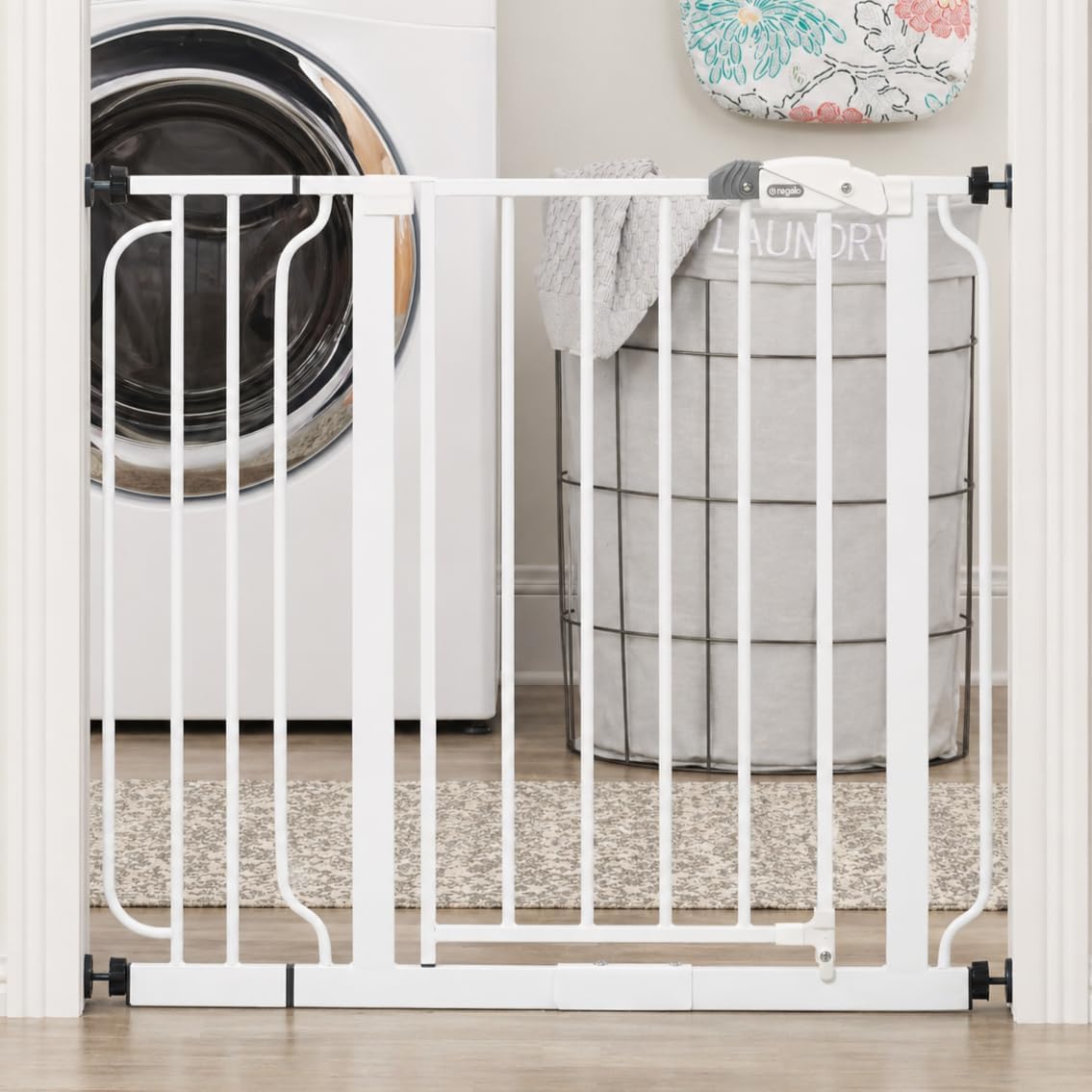
Navigating the myriad of baby gates can be daunting, so we’ve narrowed down our top recommendations for 2026 based on their safety features, ease of use, and adaptability to different home layouts. Our hero product, the Regalo Easy Step Gate, stands out for its versatility and value, particularly for standard doorways and the bottom of stairs. Its pressure-mount system makes installation tool-free and quick, which is ideal for temporary placement or households where wall drilling isn't an option. The walk-through design with a convenient one-hand release latch is a major plus for busy parents. While primarily a pressure-mount gate, Regalo does offer hardware-mount kits for safer top-of-stairs use, emphasizing the importance of correctly understanding its installation for each specific location. This gate is a solid choice for containing toddlers within designated areas, but remember to always use the hardware-mount option if installing at the top of stairs.
For dedicated stair safety, especially at the top, a hardware-mount gate with no bottom bar is non-negotiable. Our top pick in this category is often a true swing-gate design that screws directly into the wall or banister. These gates provide an immovable barrier and eliminate the trip hazard inherent in many pressure-mount designs. We look for models with durable steel construction, a wide opening for easy adult passage, and a secure latch that requires a two-step adult action to open, preventing curious little hands from figuring it out. Brands like Munchkin or Evenflo consistently offer reliable hardware-mount options that meet these stringent safety requirements for stair use.
Addressing wide openings or irregular spaces requires a different approach. For these areas, multi-panel or extra-wide gates that can be configured to fit unique angles are essential. These often come as hardware-mounted systems that can span large distances, such as open-plan living areas or odd-shaped openings between rooms. Look for gates with robust connectors that securely hold panels in place and ensure the gate meets current safety standards for stability across its full span. Some models even allow for play-yard configurations, adding extra utility. Our focus remains on durable construction and a secure, childproof latch, ensuring that even the widest openings are safely managed without compromise. Always double-check the maximum width capacity and installation requirements for these specialized gates to ensure a perfect fit for your home.
Key Features: What to Look for in a Baby Gate
Choosing the best baby gate for your home in 2026 involves more than just picking a popular brand; it requires understanding the core features that contribute to safety and convenience. Foremost among these is the mounting type. Gates are broadly categorized into hardware-mounted and pressure-mounted. Hardware-mounted gates are screwed into your wall or door frame, offering superior stability and making them the only safe option for the top of stairs. They eliminate the risk of the gate being dislodged by a child pushing or leaning against it, a critical factor for elevated locations.
Pressure-mounted gates, on the other hand, use tension to stay in place. While convenient for quick installation and often portable, they are never safe for the top of stairs due to the potential for a child to dislodge them. These gates are best reserved for doorways between rooms or at the bottom of stairs where a fall would lead to a level surface, not a drop. CheeklyPicks specifically recommends models like the Regalo Easy Step Gate for such applications, offering a balance of ease of use and security for appropriate settings. Look for features like a visual indicator to confirm correct pressure installation, which adds an extra layer of reassurance.
Another crucial feature is the opening mechanism. Most modern gates offer one-handed operation, a must-have for parents often carrying a child. Double-locking systems are also common, requiring two distinct actions to open the gate, preventing toddlers from figuring out how to unlatch it. Consider the width adjustability; gates designed for wide openings often come with extension kits, ensuring a snug and safe fit without leaving gaps. Also, assess the material construction, prioritizing durable steel or strong wood over flimsier plastics that might not withstand repeated use or a determined toddler. Finally, ensure the gate meets current safety standards, which are continuously updated to address new findings and prevent hazards. For more on keeping your little one safe, explore our guide on Bassinet Safety in 2026: Features, Recalls & Safer Alternatives.
Installation & Placement: Maximizing Safety
Correct installation and strategic placement are paramount to a baby gate's effectiveness. For any gate positioned at the top of stairs, hardware-mounting is non-negotiable. This involves drilling pilot holes and securely attaching the gate to wall studs or sturdy banisters. While this requires a bit more effort upfront, it provides the most secure barrier against falls. Always follow the manufacturer's instructions precisely, as incorrect installation can compromise the gate's integrity. For instance, the Regalo Easy Step Gate, while offering pressure-mount convenience for certain areas, also has specific hardware-mount options for top-of-stairs use, emphasizing versatility within safe guidelines. Pay close attention to the direction the gate swings; ideally, it should open away from the stairs to prevent accidental pushing into the stairwell.
For doorways and the bottom of stairs, pressure-mounted gates can be an effective and convenient solution, provided they are installed correctly and regularly checked. The key here is achieving sufficient tension against the door frame. Many pressure-mounted gates feature indicators that visually confirm when the gate is properly tightened. Regularly check the tension as changes in humidity or temperature can cause frames to shift slightly, loosening the gate's grip. Never use a pressure-mounted gate if it feels wobbly or can be easily dislodged. The bottom of the stairs is a suitable location for a pressure-mount because if a child does manage to dislodge it, they would fall onto a level surface, minimizing injury risk compared to a fall down a flight of stairs.
When positioning gates, ensure there are no gaps larger than 3 inches between the bottom of the gate and the floor, or between the gate and the wall, as a child could squeeze through or get trapped. Avoid placing gates where a child could use nearby furniture to climb over them. Always install gates at the correct height, typically at least 29 inches tall, but higher if your child is a proficient climber. Regular maintenance checks, tightening screws, and ensuring latches are working smoothly will extend the gate's lifespan and, more importantly, maintain its safety integrity. Never underestimate a child's determination to overcome barriers; a well-installed gate is your first line of defense.
When Not to Use a Baby Gate & Alternatives
While baby gates are indispensable tools for childproofing, there are specific situations where their use is either unsafe or ineffective. Firstly, never use a pressure-mounted gate at the top of stairs. The risk of a child pushing it loose and falling down the stairs is too great, even with the most advanced pressure-mount designs. For this critical location, only a hardware-mounted gate, securely screwed into the wall or door frame, is acceptable. Similarly, if a gate cannot be installed without leaving gaps larger than 3 inches, or if your child can easily climb over it, it's time to re-evaluate the solution.
Baby gates are generally not recommended for situations where they would create a tripping hazard for adults, such as across narrow hallways that are frequently used. For very wide or irregularly shaped openings, standard gates may not fit, and attempting to force an ill-fitting gate can compromise safety. In such cases, specialized extra-wide or configurable gates designed to create playpens or barriers in larger areas might be more appropriate. These often feature modular panels that can be arranged to fit unique spaces securely. However, always ensure they are anchored to at least one sturdy surface to prevent tipping.
As children grow, gates eventually become obsolete. Once a child begins to consistently climb over a gate, or if they are taller than three-quarters of the gate's height, the gate no longer serves its safety purpose and can actually become a climbing hazard. At this stage, typically around two years old or earlier for advanced climbers, it’s time to remove the gate and explore other safety strategies. Alternatives might include teaching stair safety directly, supervising children more closely in previously gated areas, or using other forms of childproofing like door knob covers or higher latches on doors to restrict access to certain rooms. The goal shifts from physical barriers to education and increased vigilance as children gain more independence and understanding of their environment.
Beyond Gates: Other Essential Baby Safety Gear
While baby gates are foundational for creating safe zones, a truly childproofed home extends far beyond doorways and stairwells. Think proactively about potential hazards at every level your little one can reach. Outlet covers are a must-have; while simple plastic plugs are common, consider sliding outlet covers for a more permanent and secure solution that's harder for curious fingers to defeat. For sharp furniture corners and edges, especially on coffee tables, hearths, and entertainment centers, corner and edge guards made from soft, impact-absorbing materials can prevent serious bumps and bruises during inevitable tumbles. Remember that even seemingly stable furniture can pose a risk. Dressers, bookshelves, and TVs should all be secured to the wall using anti-tip furniture straps. This is a critical step, as tip-over incidents can cause severe injuries or fatalities, and many furniture pieces, particularly those not designed with specific anti-tip features, are surprisingly unstable when a child attempts to climb them.
Beyond physical barriers, monitoring and awareness play a crucial role. When your child begins to explore, especially in areas like the kitchen or bathroom, cabinet and drawer locks become indispensable. There's a wide range available, from magnetic locks that require a key to simple latches that adults can easily open but tiny hands cannot. Always prioritize locks for cabinets containing cleaning supplies, medications, sharp objects, or anything else toxic or dangerous. For windows and cords, ensure cordless blinds are used, or that all cords are secured high and out of reach, as dangling cords present a serious strangulation hazard. Additionally, window guards or stops can prevent windows from opening wide enough for a child to fall through, especially on upper floors.
Consider the broader environment: hot water heater temperatures should be set no higher than 120°F (49°C) to prevent scalding. Smoke detectors and carbon monoxide detectors should be installed and regularly tested on every level of your home, and in sleeping areas. For parents who want an extra layer of peace of mind regarding their child's location and safety, especially when out and about or in larger homes, devices like the Elepho eClip Review (2026): A Wearable Location Clip, Not a Monitor can offer a valuable tool, providing alerts if a child strays too far. Ultimately, comprehensive baby proofing is an ongoing process that evolves as your child grows and develops new skills. Regularly reassess your home from a child's perspective, crawling around to spot potential dangers you might otherwise overlook, and adapt your safety measures accordingly.
Related CheeklyPicks guides & reviews
Keep researching with these CheeklyPicks pages—each one answers a related buying question without repeating the same thin affiliate fluff:
Frequently asked questions
What's the difference between a hardware-mount and pressure-mount baby gate? Hardware-mount gates attach directly to your wall or door frame with screws, offering the most secure installation, essential for the top of stairs. Pressure-mount gates use tension to stay in place, making them easy to install and move, but they are only safe for doorways or the bottom of stairs where a fall wouldn't be as dangerous.
Can I use a pressure-mount baby gate at the top of stairs? No, you should never use a pressure-mount baby gate at the top of stairs. These gates can fail under pressure, creating a serious fall hazard. Always use a hardware-mounted gate at the top of stairs for maximum safety and stability.
How do I choose the right size baby gate? Measure the width of the opening where you intend to install the gate. Most gates come with adjustable widths, but some wider openings may require extension kits. Always check the manufacturer's specified dimensions and ensure a snug, secure fit.
What age is appropriate for using baby gates? Baby gates are typically used for children aged 6 months to 24 months, or until your child is capable of climbing over the gate. Always monitor your child's development and discontinue use if they can safely clear the gate.
Enlace de pago / #CommissionsEarned. Como Asociado de Amazon, gano comisiones por compras que califican. Más información